


SSL Certificate Ensure the security of your website.
- Rank Higher in Search Results
- Boost Your Brand Credibility
- Accept Payments with Virtual POS
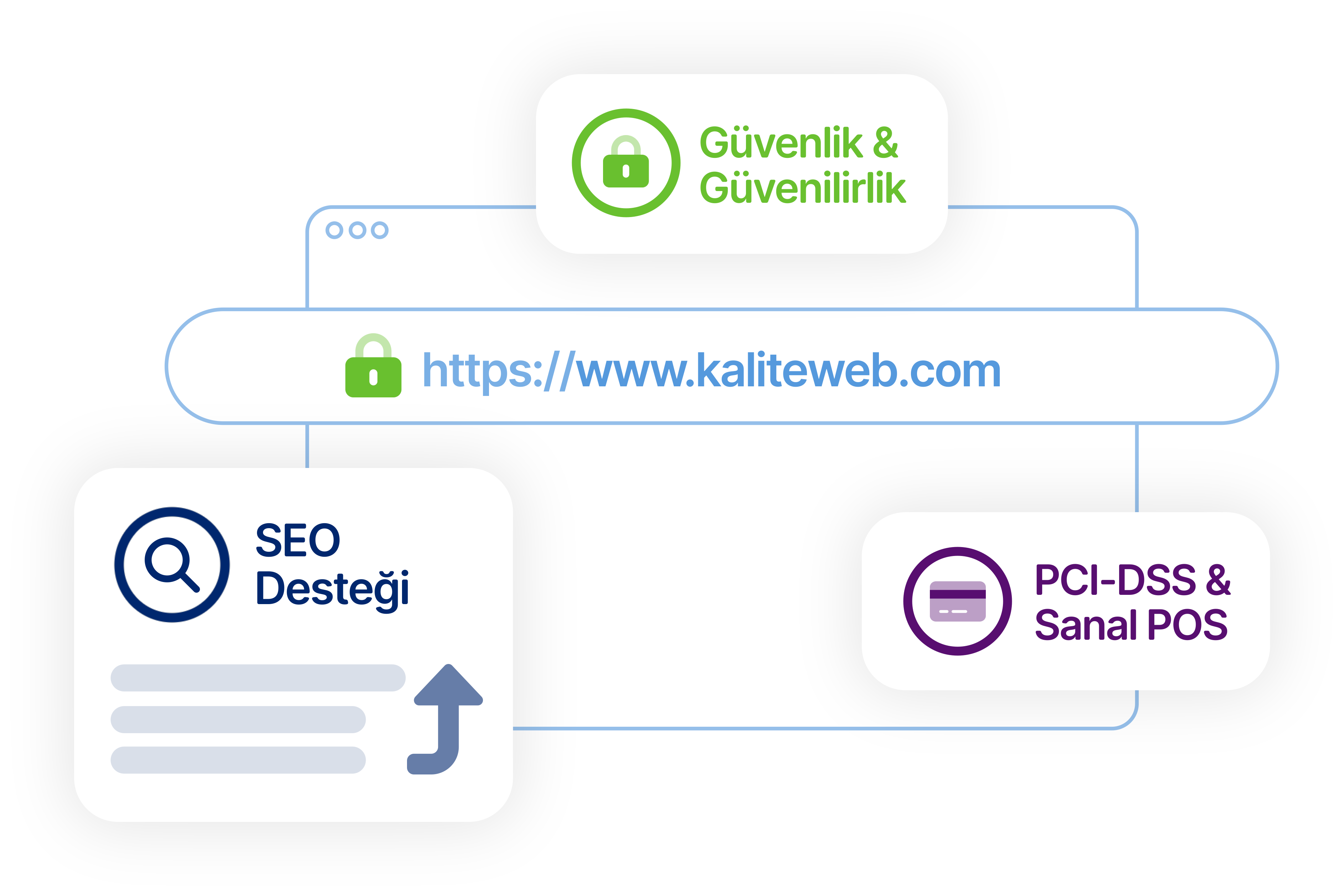

- Certificate Type: DV SSL
- Domains: 1
- Subdomains: 0
- Server Unlimited
- Encryption: 256-bit ECC
- Insurance: $50.000
- Verification: Email/Hash/DNS
- Browser Support: %99,6
- Document: Not required.
- Setup: Same Day
- Certificate Type: DV SSL
- Domains: 5
- Subdomains: 0
- Server Unlimited
- Encryption: 256-bit ECC
- Insurance: $50.000/SSL
- Verification: Email/Hash/DNS
- Browser Support: %99,6
- Document: Not required.
- Setup: Same Day
- Certificate Type: Wildcard SSL
- Domains: 1
- Subdomains: Unlimited
- Server Unlimited
- Encryption: 256-bit ECC
- Insurance: $50.000
- Verification: Email/DNS
- Browser Support: %99,6
- Document: Not required.
- Setup: Same Day
An SSL (Secure Sockets Layer) certificate is a digital document that encrypts communication between a website's visitors and the server, making it secure. Thanks to this certificate, information sent to your website cannot be intercepted by third parties, ensuring data security. An SSL certificate typically causes the website to appear as “https://” in the browser and displays a lock icon in the browser.
SSL certificates verify website identity and show visitors that the site is secure. This allows users to safely share their personal information, payment details, or passwords. SSL is a fundamental security measure for all websites, including e-commerce sites, membership-based sites, and sites with payment forms.
An SSL certificate ensures the security of user information and provides protection against data theft or malicious attacks. Especially in processes such as online shopping, payment transactions, or personal information collection, data is transmitted openly and can be easily intercepted without SSL.
Additionally, an SSL certificate increases user trust and ensures the site has a professional appearance. Google and other search engines also consider sites that use SSL to be secure, making it an important factor for SEO. Sites without SSL may be flagged as “unsafe” by users and can lead to a loss of visitors.
A wildcard SSL certificate is an SSL certificate that covers all subdomains of the same domain name, not just a single domain name. For example, a wildcard SSL certificate like *.example.com protects all subdomains such as blog.example.com, shop.example.com and mail.example.com .
These types of certificates offer cost and management advantages for sites with multiple subdomains. Since you can protect all subdomains with a single certificate, there is no need to purchase separate SSL certificates, and the installation process is simplified.
256-bit ECC (Elliptic Curve Cryptography) encryption is a modern encryption method that enables SSL certificates to strongly protect data communication. Compared to classic RSA encryption, ECC offers the same level of security with shorter keys and reduces the processing load.
This encryption method is particularly suitable for financial transactions requiring high security, virtual POS usage, or large data transfers. ECC is a preferred SSL encryption standard in terms of both security and performance.
Yes, using SSL is important for search engine optimization (SEO). Google considers sites that use SSL to be secure and gives them a slight advantage in rankings. Sites that operate with HTTPS gain priority in terms of user experience and security.
In addition, sites without SSL may be marked as “Not Secure” by browsers, which can lead to visitor loss and consequently a drop in traffic. From an SEO strategy perspective, SSL is no longer a preference but is now considered an almost mandatory criterion.
Virtual POS is a virtual payment terminal used to accept online payments and ensures secure data transmission with an SSL certificate. PCI-DSS (Payment Card Industry Data Security Standard) compliance refers to systems that process credit card information meeting specified security standards.
An SSL certificate ensures that data is transmitted in encrypted form during payments made via virtual POS and helps meet PCI-DSS requirements. This protects user information and ensures that the business fulfills its legal and security obligations.
SSL device/browser support indicates whether the certificate works seamlessly across different browsers and devices. Modern SSL certificates are designed to work on all popular browsers, including Chrome, Firefox, Safari, Edge, and mobile browsers.
This support ensures that users see the secure connection icon and that data security is guaranteed regardless of which device or browser they use to access the site. An incompatible SSL certificate can negatively impact the user experience and reduce trust in the site.
The documents required for SSL installation depend on the type of certificate. For Domain Validation (DV) SSL, only domain name verification is sufficient; no additional documents are required.
Your SSL certificates will be delivered on the same day as your order.